
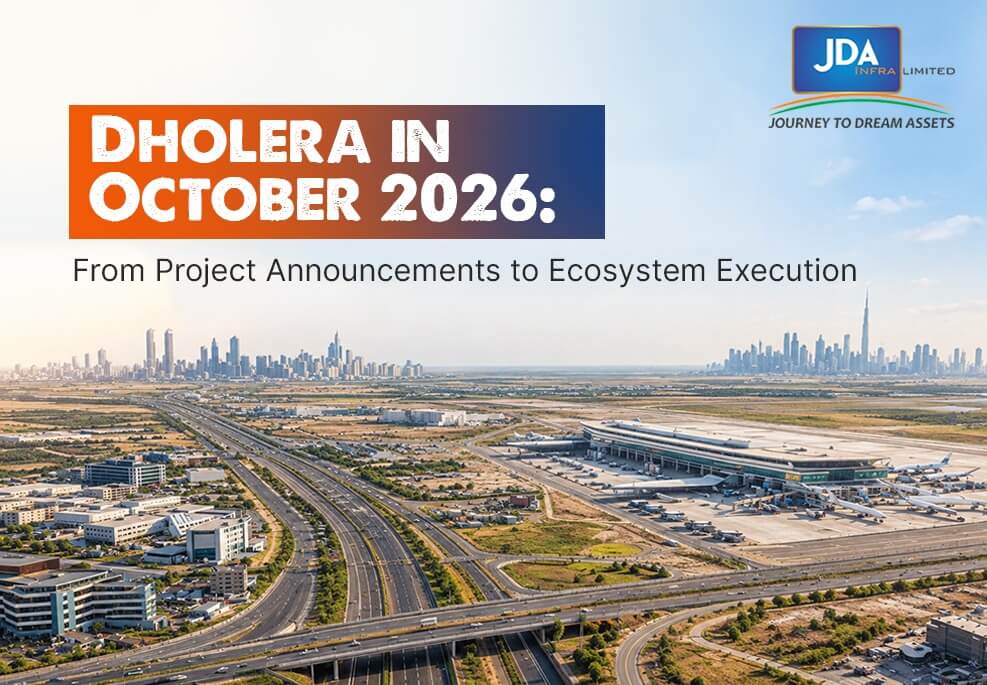
2026 will see Dholera reach an important juncture in its development journey. For many years, Dholera has been a part of the discussions on India’s future smart cities and industrial corridors. However, it is now even more important to consider the progress made in terms of infrastructure, industry, and economic development of the region as a result of those plans.
It is important to understand this point since the announcement of the project may bring attention to the project, but construction of the road infrastructure, utilities, industrial capacity, and business-to-business connections are the things that make the project real.
Dholera Special Investment Region (DSIR) is currently developing a planned greenfield industrial city of the Delhi-Mumbai Industrial Corridor (DMIC). As per the information provided by the National Industrial Corridor Development Corporation (NICDC), DSIR has a planned area of around 920 square kilometres, of which 22.54 square kilometres represent an important part of its activation area. Trunk infrastructure of the Activation Area has been built nearly fully according to NICDC.
It is important to keep in mind this important stage when considering the development of Dholera in October 2026.
Also, for any prospective investor and businesses, this would be a very effective approach towards evaluating the area. The true value of Dholera does not come from any particular project, but rather how all the pieces fit together.
Why October 2026 Is an Important Point in Dholera’s Development
From the outset, the ultimate vision of Dholera has never involved the construction of just any other typical residential township. The goal has been to develop a synergistic blend of industrial and urban zones where each will benefit the other in some way.
The significance of the current phase lies in the assessment of its development in various ways. Some infrastructure is already up and running while others are in process or have been approved for implementation in the next few years.
Take the example of the project information provided by NICDC, whereby the Activation Area is the main development zone that has trunk infrastructure to support the following industrial development. Also, there are transport projects and industrial investment programs contributing to the expansion of development in the region.
Thus, the picture provides a more realistic perspective in which to view Dholera in 2026. Not only can we assess its future possibilities but also see what it already has to offer.
From Infrastructure Announcements to Physical Development
Infrastructure will provide the backbone for the overall economic objectives of Dholera. The industry will not function effectively without good roads, electricity, water, drainage, sewage disposal and communications.
All these elements of infrastructure are part of the development plan for Dholera. The philosophy adopted by the NICDC stresses the importance of providing planned infrastructure to create the conditions for industrial investors to invest and set up industries without establishing all the basic infrastructure elements individually.
There are even examples of the implementation of this philosophy. The overview provided by JDA Infra shows the completion of projects such as ABCD Building, Raw Water Transmission System and Phase I Adhiya River Bunding. It also lists works-in-progress such as parts of Canal Front Development, Service Area Buildings and other infrastructure.
The role of these different projects may vary. But it is clear from them that the execution of the infrastructure should be evaluated as an interlinked system rather than one big headline event.
The water infrastructure caters for both the industrial and urban needs. Drainage and flood protection projects provide for the resilience of the area. Road construction and service areas improve planned areas.
The next task would be to ensure that such systems are developed, maintained, and integrated into the requirements of businesses and communities as development continues.
Road Connectivity: A Major Milestone in Regional Access
Road connectivity remains one of the best illustrations of how the development process in Dholera has reached the stage of practical realization.
The 109-km Ahmedabad-Dholera Greenfield Expressway has made the road link between Ahmedabad and Dholera SIR more stable. According to the Ministry of Road Transport and Highways, the Ahmedabad-Dholera Greenfield Expressway was opened to public testing in February 2026.
In terms of business, this link is expected to increase accessibility of suppliers, employees, commercial centres and, therefore, movement of equipment, construction materials and industrial goods.
Nevertheless, road connectivity is just the start. The economic significance of road connectivity would be defined by how effective it links internal roads, industrial plots, logistics infrastructure and transportation systems.
The main message is that infrastructure becomes commercially significant when different elements interact. The constructed road increases the level of accessibility, while the transport system supports broader economic activities.
Rail and Airport Development: Building the Next Layer
Connectivity development for Dholera’s future includes development of rail and airport connectivity, both of which are critical to its industrial growth aspirations.
The Union Cabinet gave the go-ahead for the semi-high-speed dual line 134 km railway track connecting Ahmedabad (Sarkhej)-Dholera at a cost of Rs 20,667 crore in May 2026 with the completion deadline stretching up to 2030-31. This would provide a rail link between Ahmedabad and Dholera SIR and Dholera airport.
The difference between granting approval and completion is crucial here. The railway is a critical piece of future connectivity, but the real impact would be felt upon construction, commissioning and integration with other transport services.
Another critical infrastructure development for Dholera is the Dholera international airport. In the review conducted in July 2026 by the Ministry of Civil Aviation, it was pointed out that the airport was developing in support of the industrial development aspirations of Dholera.
Industrial Investment Must Translate into an Ecosystem
Infrastructure does not mean much without a following up development of business operations, logistics and job creation and supporting services.
In the case of Dholera, some sectors that could make a good contribution include semiconductors, aerospace and defense, solar components manufacture, green hydrogen, pharmaceuticals and heavy engineering. Each of these sectors has its unique needs but all of them require utilities, logistics and availability of skilled labour.
Take, for instance, the production of semiconductor parts which requires highly specialised facilities along with stable power and water infrastructure. The ecosystem around could need a range of support from equipment provision to specialists.
Thus, the transition from industrial promises to real production is one of the indicators of the city’s progress. The investors should differentiate the proposed investment from the approved projects, construction and operation of facilities.
In any case, the development of these stages will give the picture of the economic ecosystem of Dholera.
What Ecosystem Execution Means for Real Estate
The development of an industrial region could affect the property market around it, although not necessarily in any immediate or uniform way.
As business operations commence, they could generate the need for residential properties, retail facilities, transport and other services. Such needs could eventually result in a more settled community around business hubs.
That is one reason why the property location is as important as the entire development story.
When buyers are looking at Dholera property, it is crucial that they consider the specific location of the planned development, its legalities, approvals, roads and status of nearby infrastructure. Not all projects which are labelled as part of Dholera would have the same distance from the industrial facilities and other infrastructure built by the government.
JDA Infra’s Place in Dholera’s Development Story
There are plotted developments in the Dholera area like Dholera Town, Dholera Town 2, Dholera Town 3, and Dholera Greenfield from JDA Infra Pvt Ltd. These are a part of the company’s range of residential plotted developments.
When analysing these plotted developments for potential buyers, one needs to go past the growth story of Dholera and look into the project.
The location, plot sizes, development stages, amenities, and documents should be analysed. One should also know what is provided already and what facilities will be provided later.
This will follow the idea of ecosystem execution where the decision for any real estate should be based on the project facts rather than just the future expectations.
What Should Investors Watch After October 2026?
The following phase in the development of Dholera is going to be affected by some concrete indicators such as the further provision of trunk infrastructure and progress in the construction of the railway and the airport as well as the development of industrial projects and the presence of auxiliary business activities.
One should pay attention to official updates and evaluate every development depending on its status. Operational infrastructure is quite a different thing compared to approved projects.
It is also vital to note that infrastructure-led development is a long-term activity and even when the prospects of the region change, the prices of individual property may not be growing accordingly.
This evaluation of documents, location, costs and investment period still matters greatly.
Conclusion
Dholera in October 2026 would be one of the critical milestones of India’s infra-led development initiative. This region’s projected industrial ecosystem would be receiving backing from various infrastructural initiatives that are going on.
However, it all comes down to whether these infrastructures are successfully coming together in a way that would facilitate industrial operations, job creation, logistics activities and urban living. This is the distinction between declaring a smart city and actually creating an economic hub.
This would be one of the critical criteria for JDA Infra Pvt Ltd and other potential investors looking into Dholera’s property developments. One must keep in mind that only facts about the projects, the actual infrastructure work done and the link between the property and its development matter.
It would all come down to not just the projects declared, but also the infrastructures created, industries set up and economic activities carried out to determine how successful the smart-city concept becomes a reality.
FAQs
1. What is the current development status of Dholera as of October 2026?
Dholera has built up necessary infrastructure in its Activation Area whereas the development of road connectivity has progressed whereas major rail and airport projects have been undertaken at various stages of implementation.
2. Why is the execution of infrastructure necessary in Dholera?
The infrastructure delivered helps to make available the necessary connectivity for business establishment and residential activities.
3. Which are the major connectivity projects that will be coming up in Dholera?
Some of the main connectivity projects include the semi high speed railway between Ahmedabad and Dholera and the Dholera International Airport along with the expressway between Ahmedabad and Dholera.
4. In what ways can industrial growth influence Dholera real estate?
There can be increased requirement of houses and other related services due to the industrial growth. But, the appreciation in value of the property is not a certainty as it is different with respect to location, documentation, market conditions and project quality.
5. What is the verification process required before buying a plot in Dholera?
Prospective buyers must check on the title papers, approvals, land use permits, actual site location, accessibility of the infrastructure and development stage of the project.