
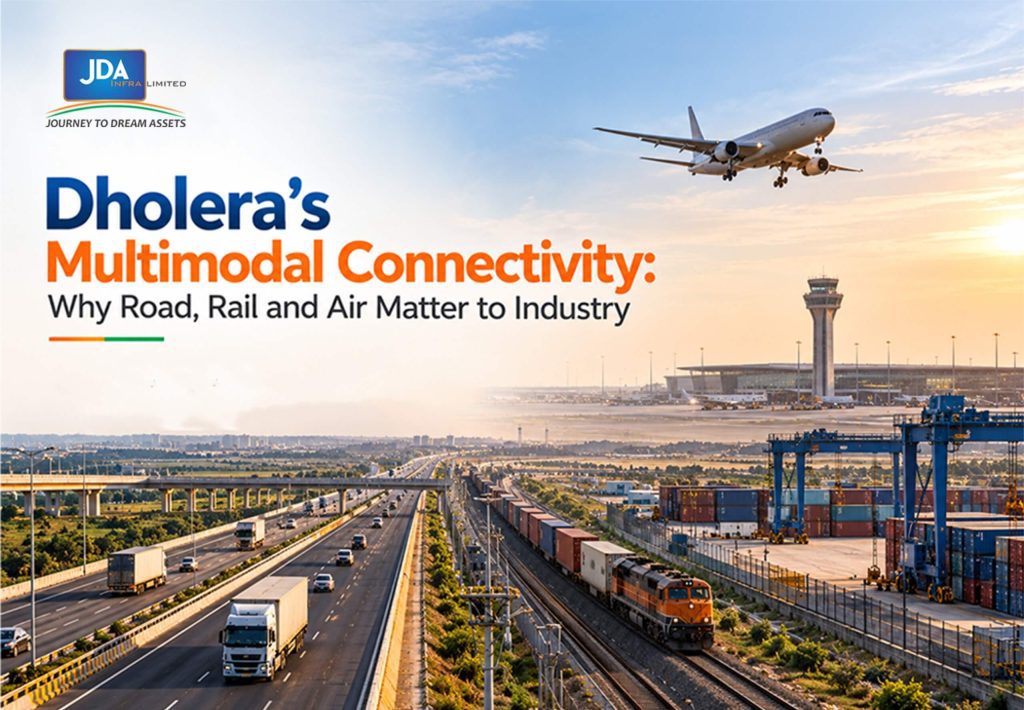
One key feature which has enabled Dholera to be a growing industrial hub for investments is connectivity. In an industrial setup, simply having land is not enough. There needs to be efficient means to transport raw materials into the factory, finished goods to markets, people to different cities and also high value cargo between various domestic and international destinations.
That is why the growing connectivity in the form of multi-modal connectivity is particularly important for Dholera. The region is getting connectivity in the form of roads, railways and airports. Some of the important examples are the Ahmedabad-Dholera expressway, Ahmedabad-Dholera semi-high speed rail and Dholera International Airport.
For businessmen, this can mean reduced travel times and better access to markets and logistics. For potential investors looking for Dholera plots for sale, Dholera projects or Dholera property, this is an important aspect to consider as well.
What Is Multimodal Connectivity?
Multi-modal connectivity refers to integrating various modes of transportation to ensure efficient transfer between the two modes of transport. In an industrial area, the road, rail, and air transport does not operate independently of each other. The two modes of transport have their own unique uses and when combined well can contribute to the movement of goods, passengers and finance.
Roads offer flexible last mile and regional connectivity while rail is important in transporting large volumes of cargo over long distances. Airports help in transporting passengers as well as time sensitive cargo.
The development of Dholera is becoming increasingly dependent on such a multi-modal connectivity approach. Recent government initiatives and the development of infrastructure suggest that there is a deliberate effort to integrate the area into Ahmedabad among other markets via multi-modal transport connectivity.
Why Connectivity Matters to an Industrial Region
An industrial investment zone requires more than just factories and industrial plots. Factories require an efficient supply chain which can provide parts, machinery, raw material to the factories and transport finished goods to customers.
Take the example of any semiconductor firm, electronic firm or an advanced manufacturing unit. Their supply chain would include suppliers located in various states, specialised machinery imported from other countries and finished products to be distributed all over India and even to other countries.
Each and every additional time taken in transportation would impact their inventory levels, production planning and operating costs.
This is where multimodal connectivity would make all the difference as they will have a choice regarding movement of goods and people through different modes of transportation.
The development of Dholera assumes significance in this regard as it has been envisioned not as a residential town but as an industrial and economic zone. Gujarat’s industrial policy has identified sectors like electronics, high technology industry, automobile and auto components, defense, heavy engineering and food processing industry as focus sectors of Dholera SIR.
Road Connectivity: The Foundation of Everyday Movement
Roads continue to be the most versatile mode of connectivity for commercial purposes. Despite the fact that goods may get transported from one place to another through rail and air in some cases, trucks are always needed to move materials from one factory to another, from warehouse to warehouse, and various distribution centres.
In this regard, the Ahmedabad-Dholera Expressway is indeed an important component of the infrastructure of Dholera.
The 109 km long greenfield expressway was built in order to facilitate faster connectivity between Ahmedabad and Dholera and provides direct connectivity towards Dholera International Airport. According to the government data released in 2026, there has been considerable improvement in travel time between the two cities via the expressway.
However, this is not all.
Roads and the Last-Mile Advantage
Another drawback associated with rail is that rail routes do not run to all factories and warehouses. The road sector provides a solution to this problem.
An industrial enterprise can get raw materials via rail for instance, but trucks might still be used to move the raw materials from a logistics hub to the factory itself. Finished goods could also move out of a factory via roads prior to transferring them to other means of transport.
Road connectivity is thus vital even in areas which are experiencing growth in rail and air connectivity.
When investing in Dholera projects, road connectivity should also be taken into account along with regional infrastructure connectivity.
Rail Connectivity: Supporting Large-Scale Industrial Logistics
In cases where an industrial area starts receiving significant amounts of freight, railroads become very important.
In May 2026, the Indian government’s Union Cabinet cleared the Ahmedabad (Sarkhej)-Dholera Semi High-Speed Double Line project, which will reportedly cost about ₹20,667 crore. The 134-km project seeks to link Ahmedabad to Dholera Special Investment Region (SIR), Dholera Airport and Lothal National Maritime Heritage Complex.
Rail connectivity would be important for both passengers and industries.
From a commuter standpoint, improved rail connectivity would make it easier for people working in professional sectors to travel to Dholera from Ahmedabad. From an economic standpoint, rail connectivity will help in improving connectivity with the rest of India’s transport systems.
In terms of other railways being constructed in the region, there are some freight lines being developed as well. For instance, one of the rail projects identified by the government is that of Bhimnath-Dholera Logistic Hub New Line.
Why Rail Matters for Industry
The rail network may prove to be a viable alternative for transporting large amounts of cargo for longer distances. For businesses that have to work with heavy machinery, bulk supplies, or large-scale production, connecting with the rail network would be an essential criterion.
Dholera can benefit from having a rail network connection because the city’s industry model would encompass advanced manufacturing and technology-based industries.
Air Connectivity: Connecting Dholera to National and Global Markets
Although road and rail are important modes of surface transportation, air connectivity is an entirely different means.
Dholera International Airport is being built as a greenfield airport which is meant to cater to Dholera SIR along with its surroundings. At the time when the project received approval, the Government of India specifically noted that there would be passengers and cargo from Dholera SIR and the airport could be used for the handling of cargo in the region.
The importance of the airport has been further emphasized due to the emergence of the industrial ecosystem of Dholera.
Industries like semiconductors, electronics, advanced technologies and manufacturing generally involve fast transfer of valuable items, specialised machinery and business people. In such circumstances, the airport could prove useful as a supplementary means of transportation.
In July 2026, the Ministry of Civil Aviation noted that Dholera would have multimodal connectivity including the airport which would be connected to the road and proposed rail links.
Road + Rail + Air: Why the Combination Matters
The true value of Dholera’s connectivity is not in any one mode of transport but in the intermixing of different modes.
Consider the scenario where an industrial organisation is importing specialised equipment. Connectivity by air will be useful in transporting such equipment timely. Once in the region, it can be moved further through road connectivity to the place of production.
In the same way, bulky material may use rail connectivity, while road connectivity may help in transporting the same to the last mile.
Connectivity through road and passenger rail transport will be of assistance to the employees, investors, suppliers, and visitors, while air connectivity will aid in accessing major destinations both nationally and internationally.
It ensures better transport connectivity.
In the case of an industrial destination, such connectivity becomes crucial as industries function on different transportation needs for their products.
How Multimodal Connectivity Can Influence Real Estate
Infrastructure and real estate have strong ties to each other.
The worth of land is not just a function of its size and environment. Connectivity can make a place more functional and appealing through time.
This has implications for what is termed as Dholera property. Places that are located at strategic locations relative to roads, workplaces, industries, and infrastructure facilities will be more appealing as connectivity improves.
For homebuyers, the benefit of connectivity lies in their proximity to work, education, medical centres and business facilities.
For companies, this could translate to good connectivity to labor, suppliers and markets.
In essence, the bigger picture of connectivity can play a very crucial role in considering Dholera plots for sale.
However, it should be noted that just because of connectivity alone, one cannot expect property appreciation. One should take into account such aspects as location, documentation, development stage, availability of infrastructure and overall quality of the project.
JDA Infra and Dholera’s Growing Development Ecosystem
JDA Infra Pvt Ltd has been instrumental in designing and listing several plotted developments in the Dholera area such as Dholera Town, Dholera Town 2, Dholera Town 3, and Dholera Greenfield. It has clearly articulated the location of its projects against the backdrop of Dholera development story.
For example, Dholera Greenfield project by JDA Infra provides plotted development with plot size available from 100 to 500 square yards and emphasizes on the proximity of its project with respect to Dholera SIR development project.
Its Dholera residential developments also emphasize on availability of infrastructure nearby such as Dholera International Airport, expressway, ABCD Building, etc.
This is important since it is impossible to detach the investment story of plotted development from the region where it is located.
Connectivity Can Support Dholera’s Industrial Ecosystem
The broader concept of Dholera SIR is founded on the notion of developing a planned economic region whereby industry, infrastructure and urbanisation co-exist.
The government literature describes Dholera SIR as a greenfield industrial investment zone with planned infrastructure that includes transportation, water supply, electricity, sewage, drainage and urban planning.
There are many ways in which the multiple modes of transport can help in realising this broader ecosystem:
● Manufacturing: Better access to raw material, equipment and markets.
● Logistics: Better transport of freight and logistics.
● Labour: Better movement of labour and professionals.
● Travel for business: Better access for investors, executives and suppliers.
● Growth of residential population: Better accessibility will drive demand for residential needs and services.
● Commercial activities: Movement of people and goods will create opportunities for business activities.
Therefore, multimodal transport is not just about transport, but can become one of the pillars of the developing industrial city.
What Should Investors Look for in Dholera?
While searching for Dholera plots for sale, connectivity would be a reasonable starting point, but not the only point of interest.
One needs to consider the location of the project, proximity to main roads, and other infrastructure. One needs to look into whether the mentioned infrastructure is actually functioning, being developed, or is expected to be developed in the near future.
Verification of project credentials such as documentation, approvals, development stage, and history of the developer is also essential.
Investment horizon of the buyer is another important point to think about. Dholera is an area under development, and it takes time for infrastructure-driven development to become a fully developed urban landscape.
The Future of Dholera’s Connectivity
The transportation system in Dholera continues to develop through projects for roads, railways, and airport connectivity that serve as integrated components of the city’s developmental agenda.
While the Ahmedabad-Dholera Expressway has provided an improved link via roads, the sanctioned semi-high speed rail project will act as a link between the cities of Ahmedabad, Dholera SIR, and the airport. Dholera International Airport is set up keeping in view the needs of passengers as well as the cargo industry.
These developments highlight the trend of making Dholera not just connected but integrated in a greater economic and logistical context.
Conclusion
The connectivity of Dholera using various modes of transport is possibly one of the most striking parts of its emerging industrial history. With road, rail and air connections, it may be possible to have a proper transportation network in place for a modern day industrial region.
To the businesses, this can result in good logistics and access to talent pool and markets while to the wider region, it may bring about jobs, business opportunities and urban development. For investors looking at Dholera property, it provides a crucial way to judge the future potential of various properties and Dholera projects.
JDA Infra Pvt Ltd’s plotted projects represent part of this larger network, enabling investors to have a look at residential lands in a region where there is considerable infrastructure and industrial development underway.
In the end, the importance of Dholera’s connectivity cannot be simply attributed to the presence of a road, a railway or an airport. The point here is to use all these facilities together in order to connect the emerging industrial city with the people, the businesses, their suppliers and the markets. And connectivity will surely continue to be crucial to the development of Dholera as an industrial destination.
FAQs
1. Importance of connectivity in multimodal manner to Dholera
Multimodal connectivity makes Dholera have different transport options to move people and goods. It can be used by the region in its development as an industrial one.
2. Importance of road connectivity to Dholera industries
Roadways help in moving flexibly between different places like factories, logistics centres, warehouses and cities. Construction of Ahmedabad-Dholera Expressway has enhanced the connection between Ahmedabad and Dholera and increased speed of transportation in the region.
3. Importance of rail connectivity to Dholera
It is useful in movement of passengers and in freight logistics on a large scale. The approved Ahmedabad-Dholera semi-high-speed rail project is going to connect Ahmedabad, Dholera SIR and Dholera Airport.
4. Importance of Dholera International Airport
This airport is being constructed for serving the needs of passengers and cargo. The Government of India considers its potential in becoming a cargo hub for the industrial region of Dholera.
5. Can connectivity improve Dholera property as an investment?
Connectivity can be one of the factors influencing property valuation but it does not guarantee that the price will appreciate in the future. Besides, there are other aspects of property evaluation like location, availability of documents, development status and project fundamentals.